A personal view · Newspaper strips · 1936–1999
Whose Phantom?
Lee Falk’s legacy, the newspaper creators and the limits of change
The Phantom belongs to Lee Falk in one sense that no contract can alter: he imagined the character and built the storytelling world from which everything else grew. But a newspaper strip is also a business, a collaboration and, eventually, an inheritance. Those different kinds of ownership do not always point in the same direction.
For me, the interesting question is not simply who is entitled to publish The Phantom. It is what the people entrusted with him should feel entitled to change.
My starting point is quite straightforward. There is room to develop what Falk left unexplained. There is room for new people, new adventures and discoveries about the past. There is much less room for replacing things that already give the character his identity. A new artist should bring a personal hand to the drawing. That does not mean the Phantom needs a new identity every time the drawing board changes hands.
Expand the world where Falk left space. Preserve the foundations where he was clear.
This essay concerns the daily and Sunday newspaper continuities, from 1936 to September 2026. Dates refer to newspaper publication, which can differ from when the work was drawn. I have followed The Phantom for more than sixty years. What follows is my personal reading of the series, shaped by the stories themselves and by the changes I have watched over that time. Other readers will see some things differently; the strips give us something concrete to discuss.
The creator, the syndicate and the reader
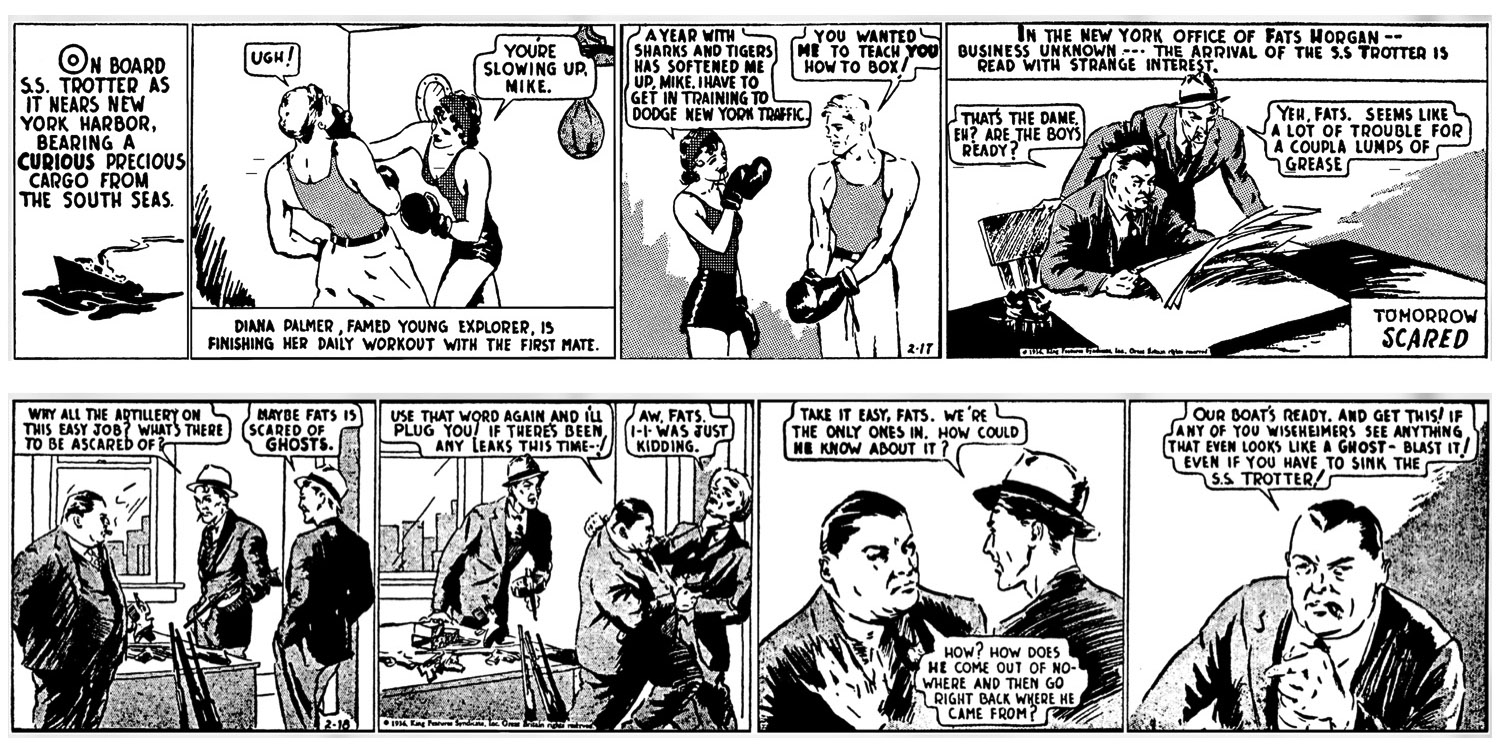
The daily strip began on 17 February 1936; the separate Sunday series followed on 28 May 1939. King Features was involved from the beginning as the syndicate bringing Falk’s creation to newspapers. Falk wrote the stories, and Ray Moore gave the early strip its visual character.
Falk created The Phantom, but later sold part of his interest in the series to King Features. That brings us to the distinction at the heart of this article: creating a character, owning a stake in it and shaping its future are not quite the same thing.
For me, Falk’s importance cannot be reduced to the share he retained or the rights he transferred. His stories established the world that later creators inherited. King Features’ position gives the syndicate influence over the series’ continuation, but the question of what makes a development faithful to The Phantom remains a creative one, too.
I think of the responsibilities in three parts. The creator supplies the original vision. The syndicate provides the organization that can keep the work in circulation beyond any one person’s working life. The writers and artists turn that continuing existence into actual stories. Readers, meanwhile, bring an attachment that cannot be measured entirely in sales or permissions.
Approval from the rights holder makes a development authorized. It does not automatically make it convincing. Conversely, a reader’s dislike does not make a story unofficial. We should be able to distinguish those things while still arguing strongly about the result.
The practical question is how that influence is used. Does the syndicate give writers and artists room to develop the series while protecting its identity? Or does the wish for something new become an excuse to change what already works? As a reader, I judge the result on the newspaper page.
Lee Falk: a world built through stories
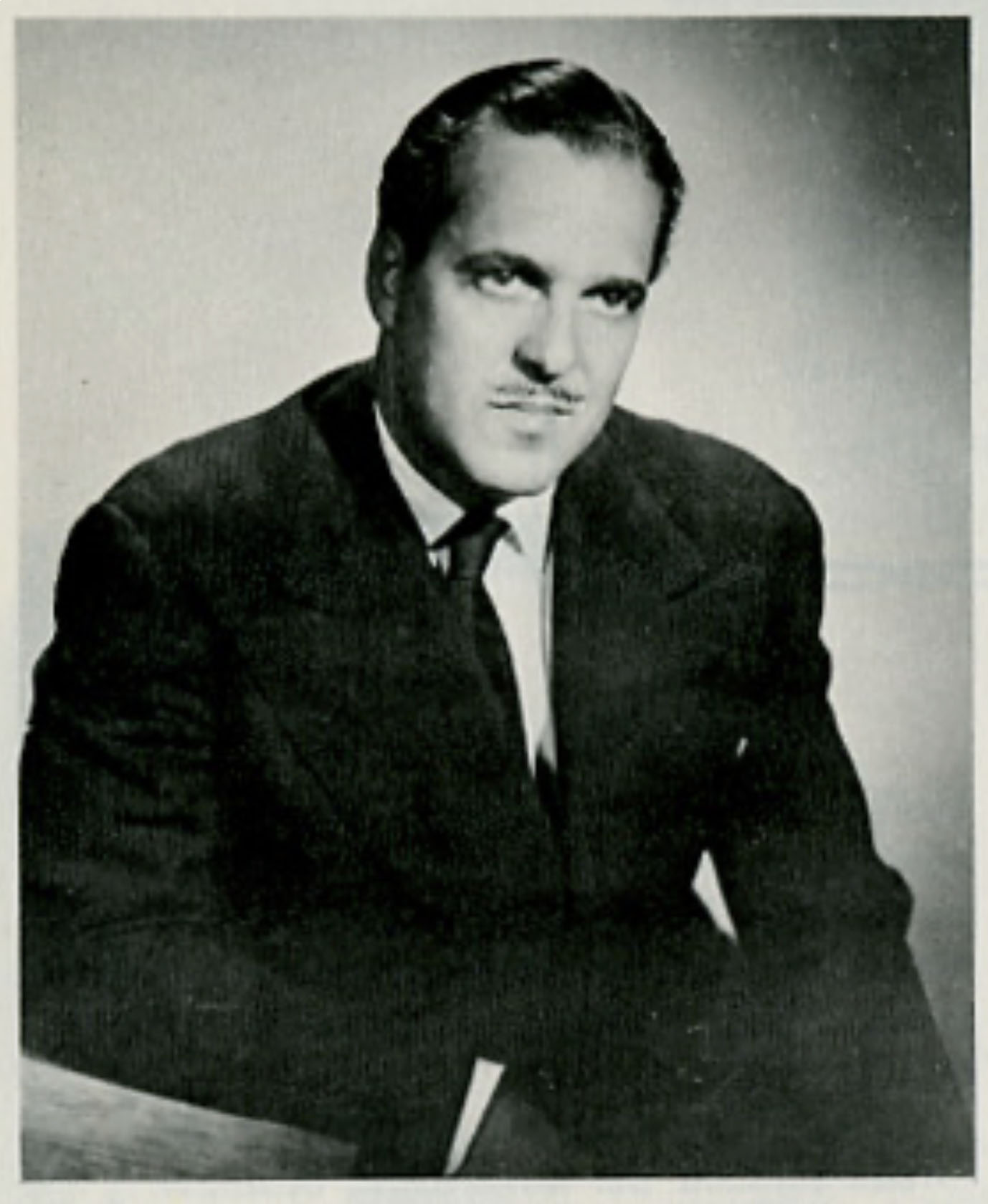 Lee Falk
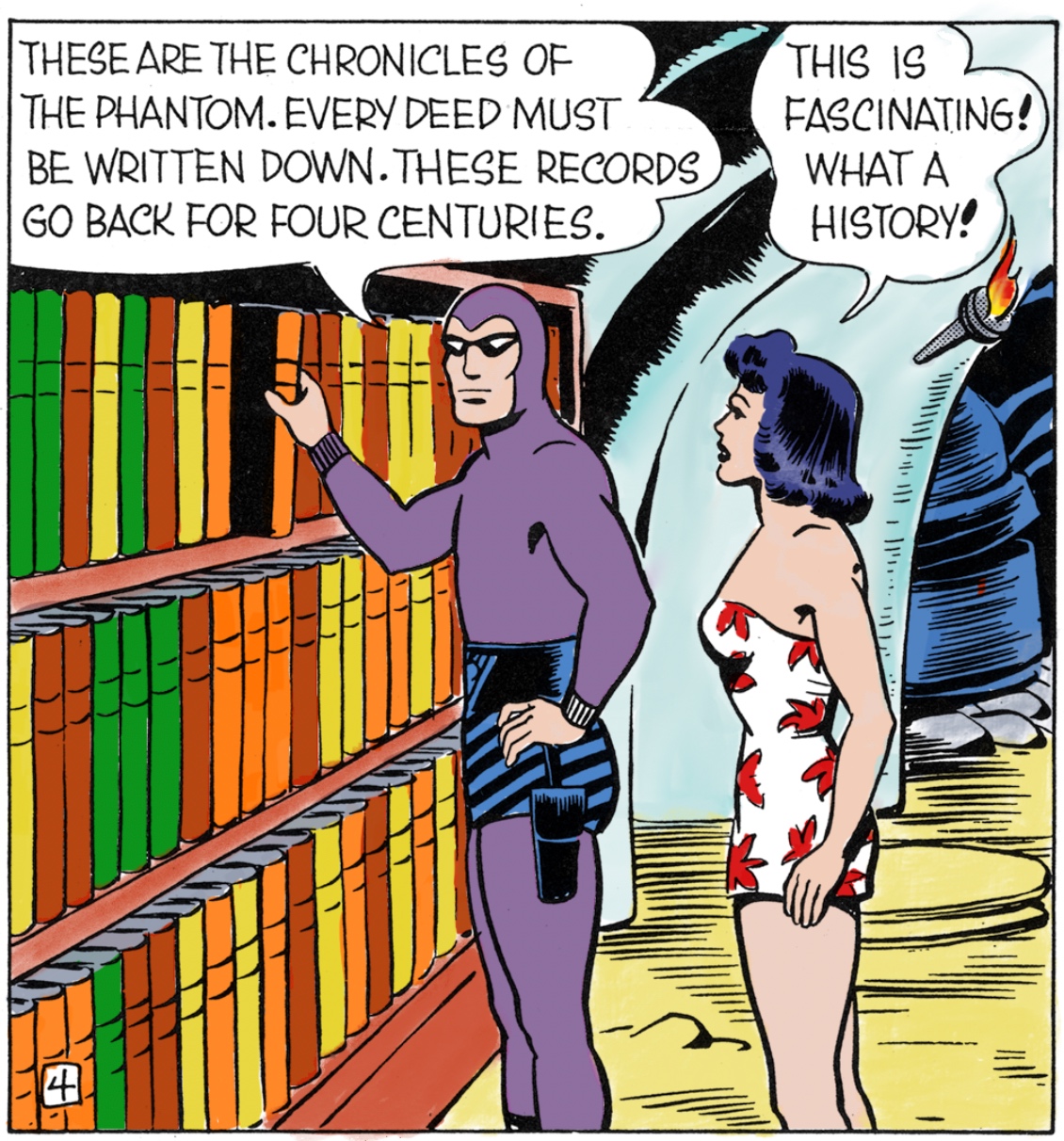
Falk worked on the strip until his death in 1999. Over that long span, the Phantom became more than a masked adventurer. The inherited oath, the Skull Cave, the chronicles, the family and the relationships around him made the series capable of looking backwards and forwards without abandoning its central figure.
I do not read that accumulated history as a specification in which every detail had been settled before the first strip appeared. Its strength is that it feels larger than any single adventure. An old object can suggest an untold story. A passing reference can open a door that another writer might later walk through.
Yet an open door is different from a demolished wall. If Falk did not tell us what happened to a supporting character, there may be room to find out. If he repeatedly established what an oath or a symbol means, a successor has a much greater burden when proposing to change it.
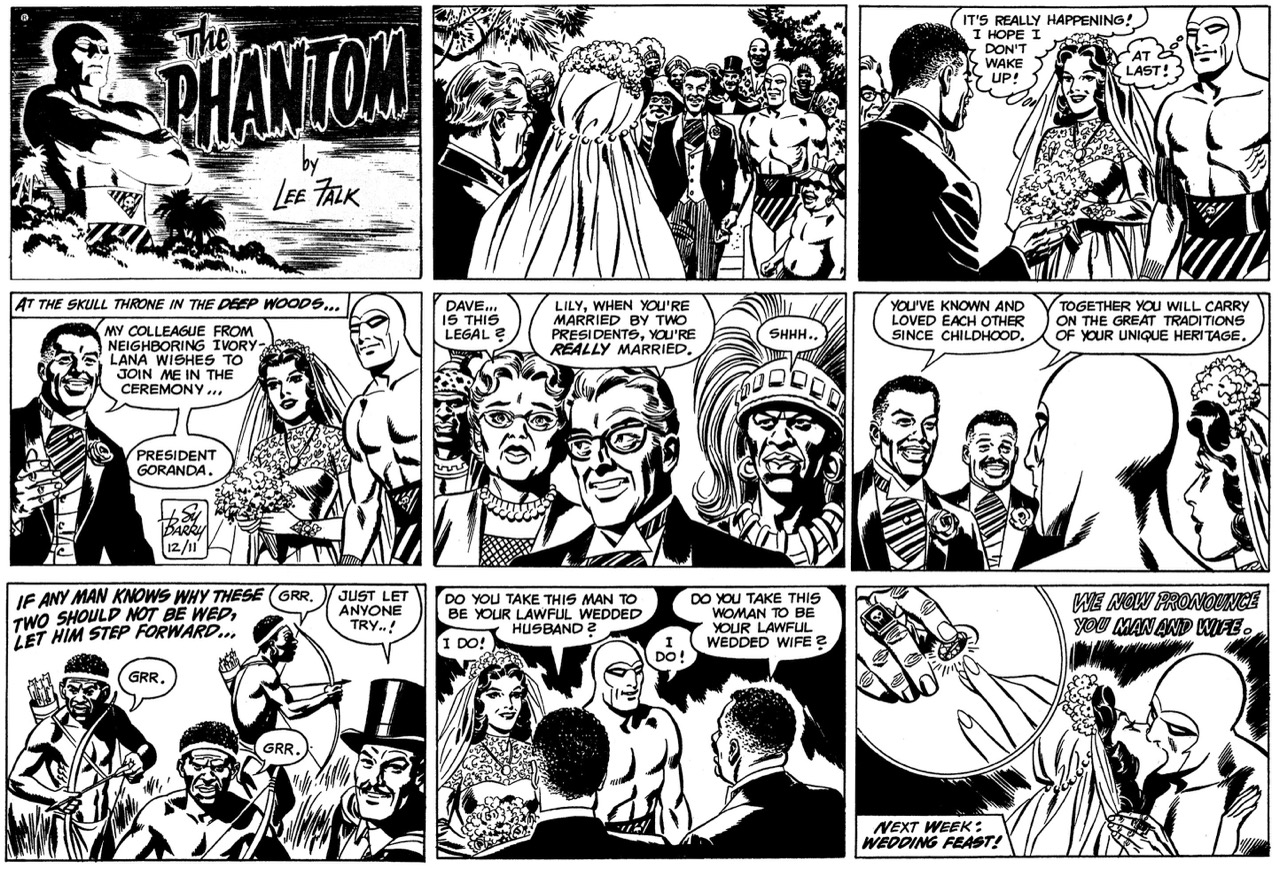
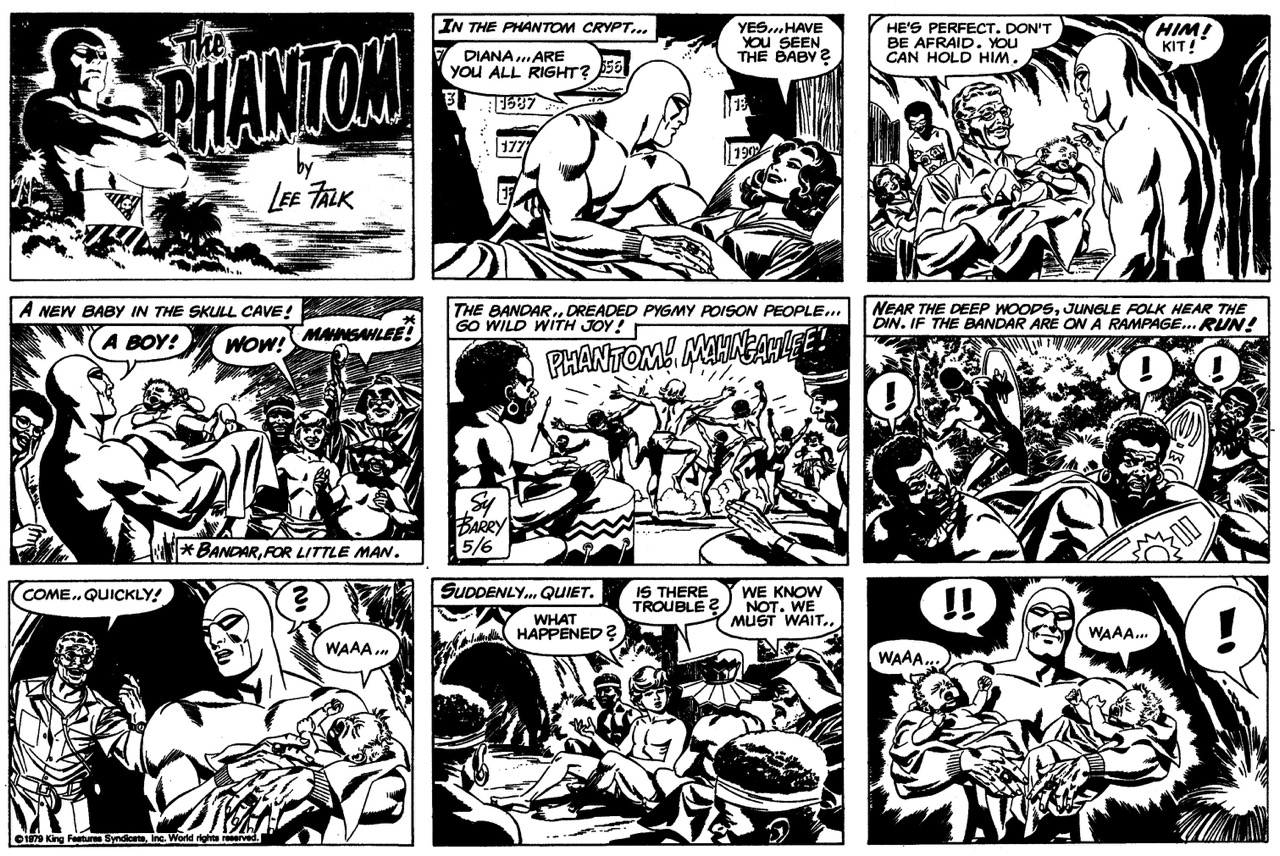
Falk’s own work also prevents us from treating all development as a betrayal. The wedding stories of 1977–78 and The Heirs in 1978–79 changed the family situation substantially. These were developments in the existing life of the character, with consequences for the stories that followed. My objection is not to consequences or forward movement. It is to alterations that make the accumulated history feel disposable.
Different hands, the same Phantom?
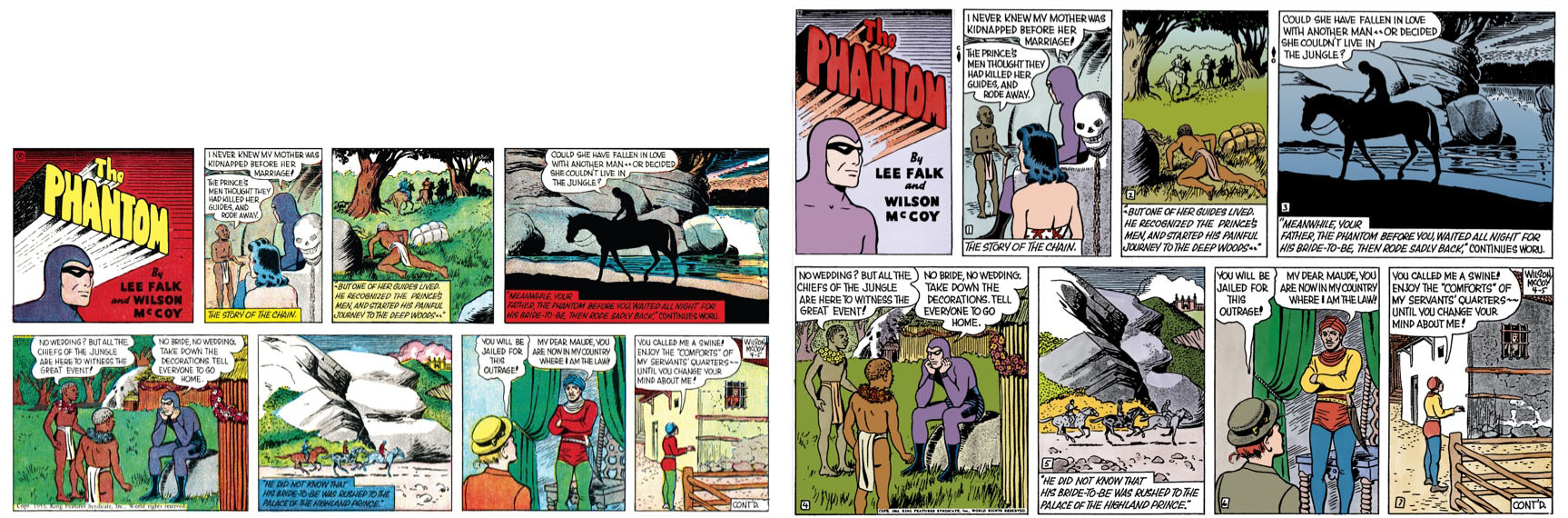
The following is a guide to the principal changes of artistic responsibility, with selected collaborators and temporary contributors. It is not a claim that every panel in a named artist’s period was drawn by that person alone. Pencilling, inking, lettering and colouring all matter. These are the differences I notice as a reader; the illustrations will help show what I mean.
Ray Moore — mystery and atmosphere
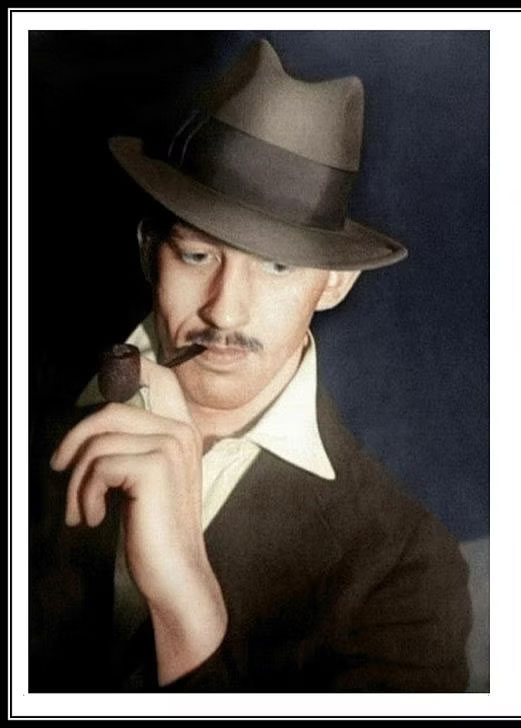 Ray Moore
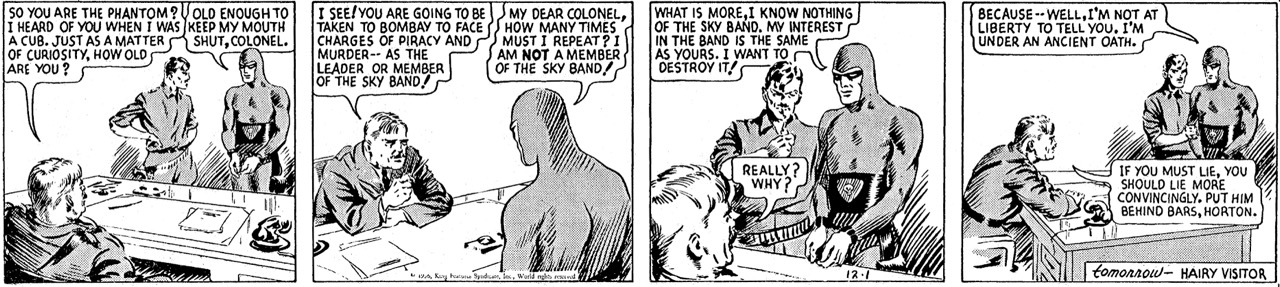
Moore gave the early strip a shadowy, romantic atmosphere. His use of darkness is particularly well suited to a hero whose reputation depends on being only partly understood. The work overlaps with Wilson McCoy’s increasing contribution during the 1940s, so a neat handover date can conceal a more complicated working history.
To me, Moore demonstrates how much the Phantom can achieve through suggestion. The character need not occupy every inch of a panel to dominate it. Darkness, distance and the reactions of other people can do some of the work.
Example to compare: The Singh Brotherhood (1936) and The Sky Band (1936–37). Look at the relationship between the figure and the surrounding shadows, as well as the treatment of faces.
Wilson McCoy — clarity and the unexpected hero
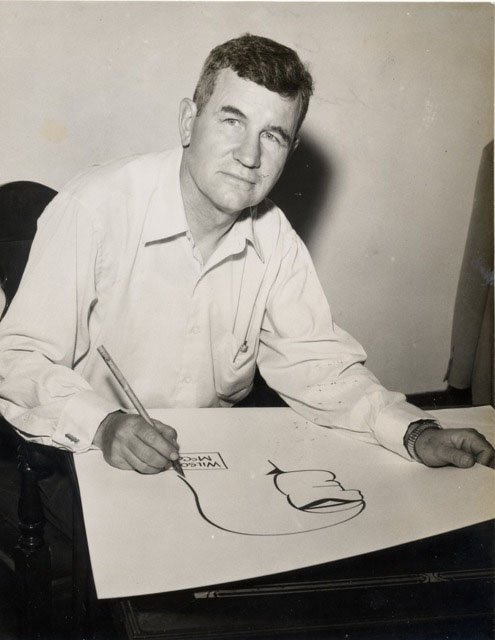 Wilson McCoy
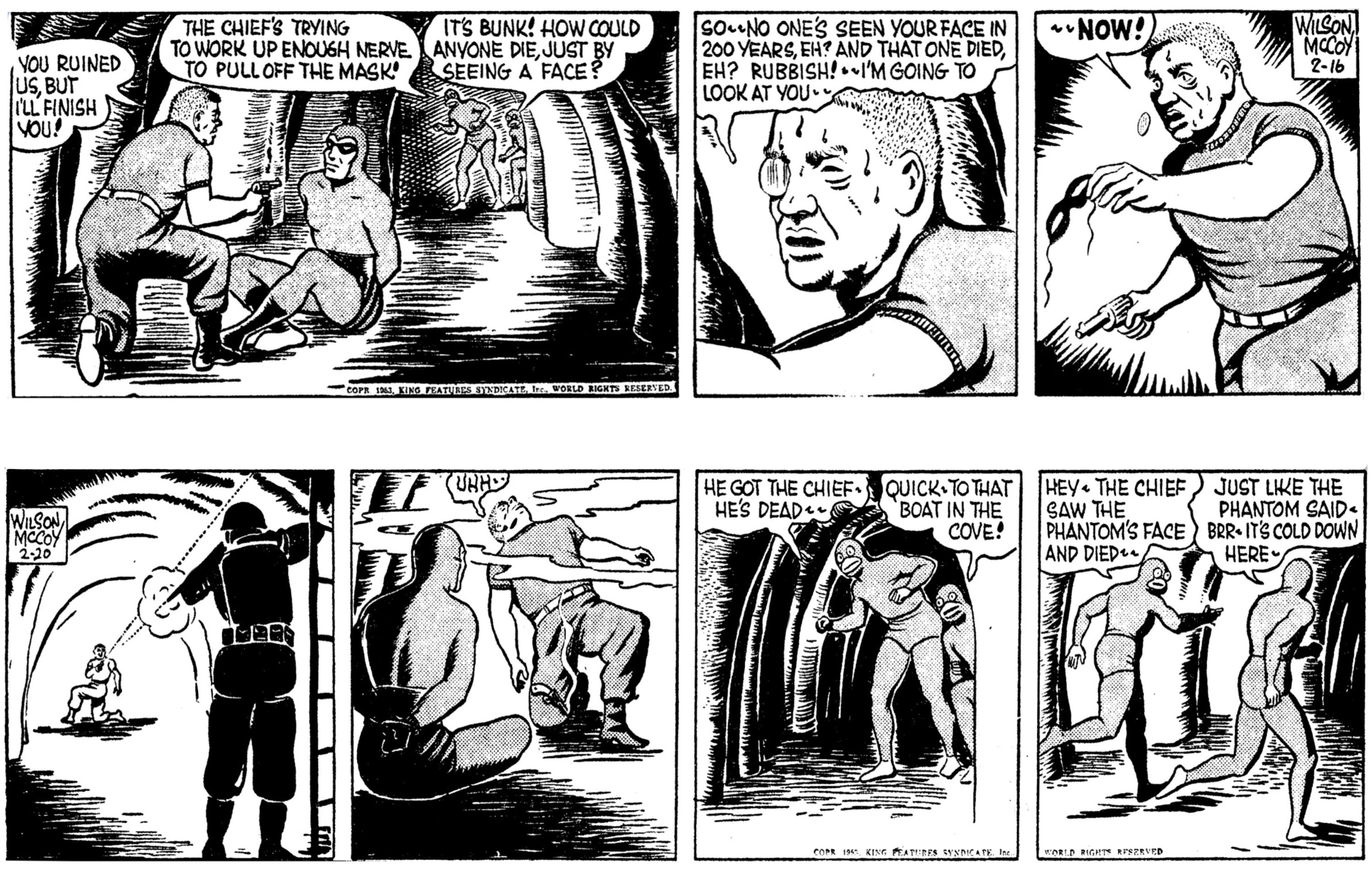
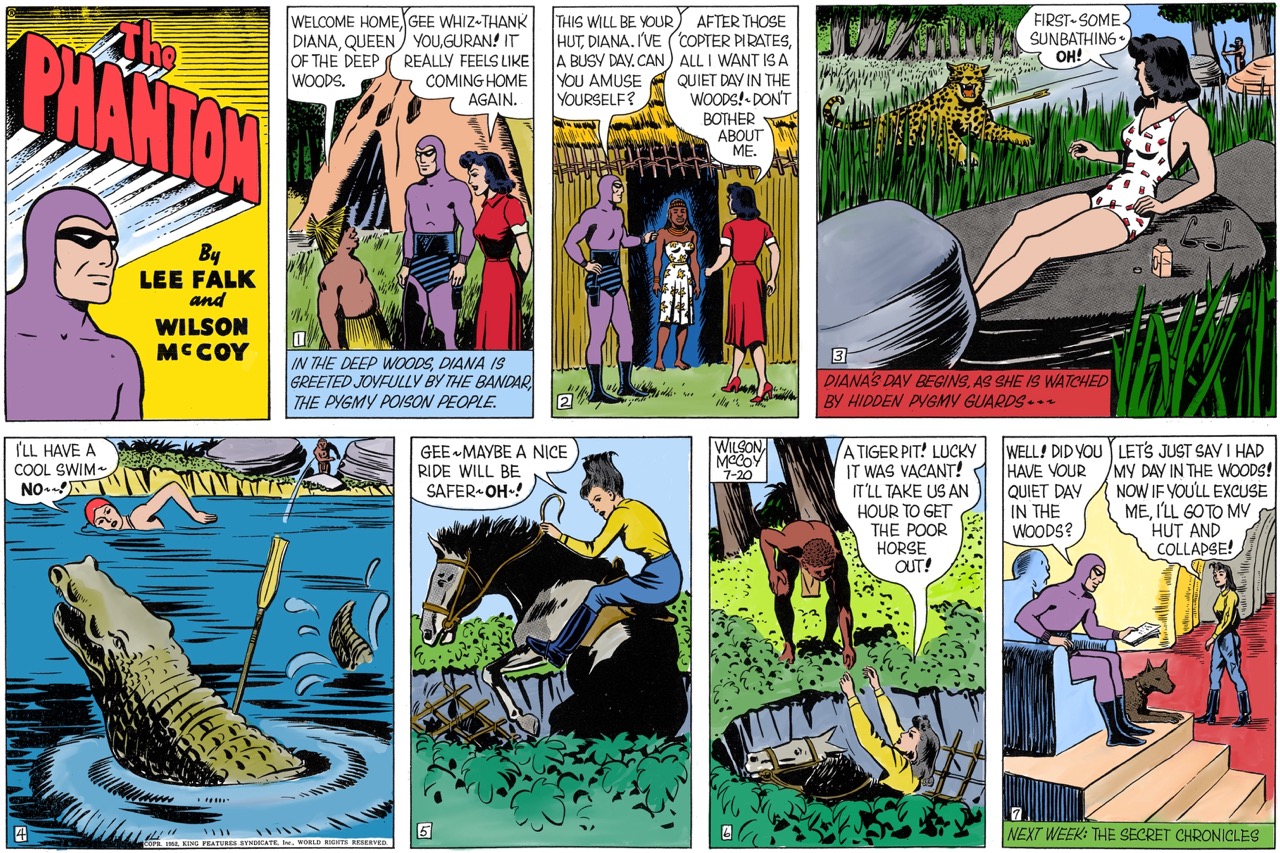
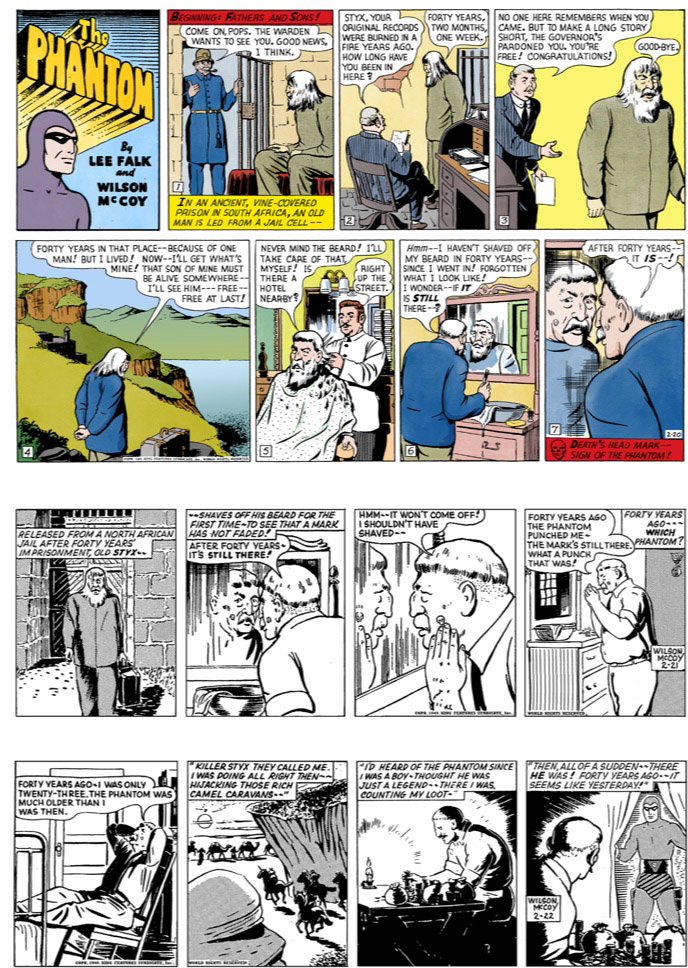
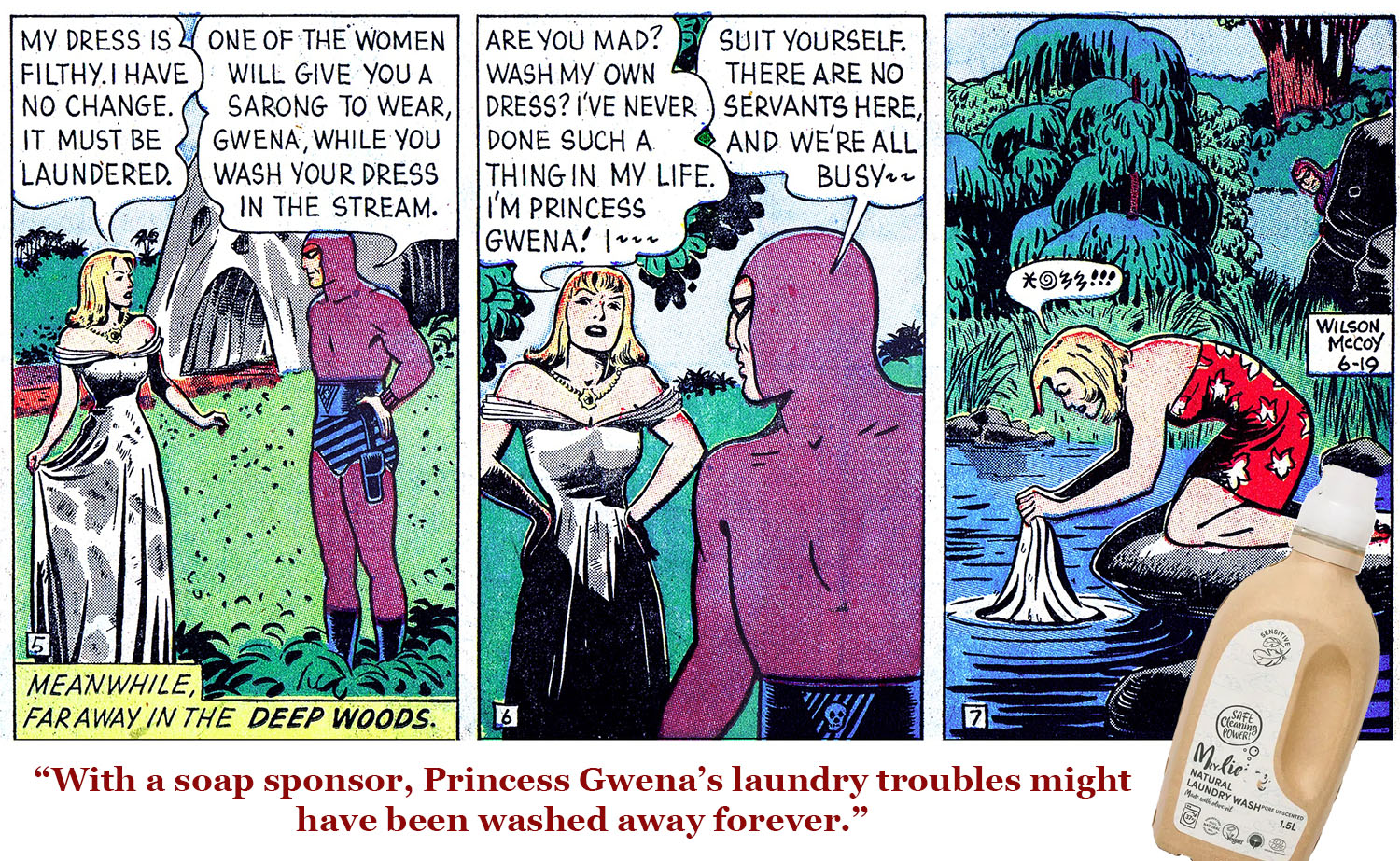
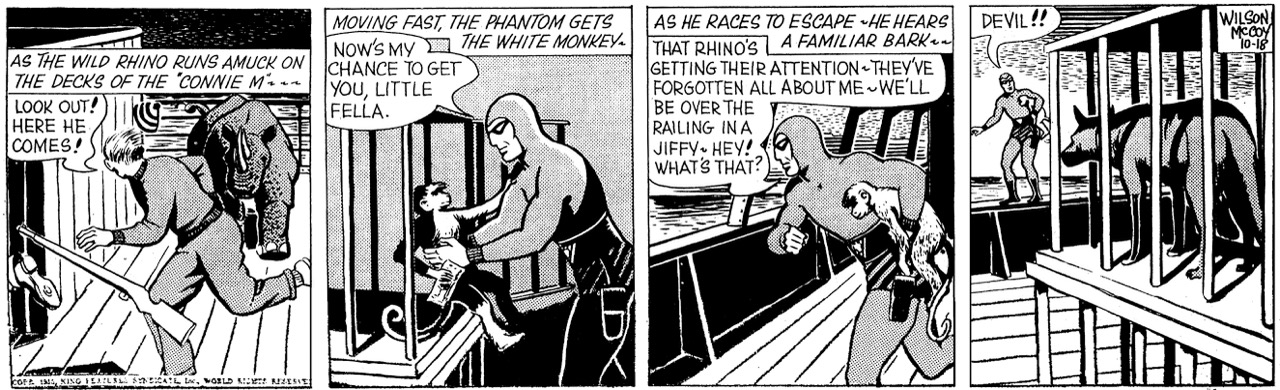
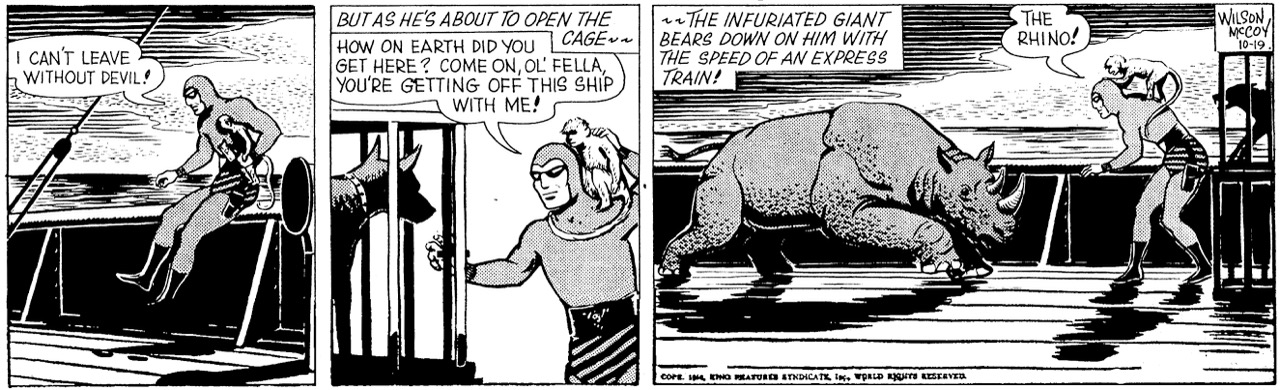
McCoy’s clear outlines and comparatively direct staging give the strip a very different character. His drawing may look simple at first glance, but he made extensive use of photographic reference. Dorothy McCoy’s lettering was also part of the production.
What interests me is the contrast between an apparently ordinary figure and an extraordinary reputation. A Phantom who does not look like the largest man in the room can be all the more effective when the room discovers its mistake. This is one reason I do not equate increasing muscle mass with increasing authority.
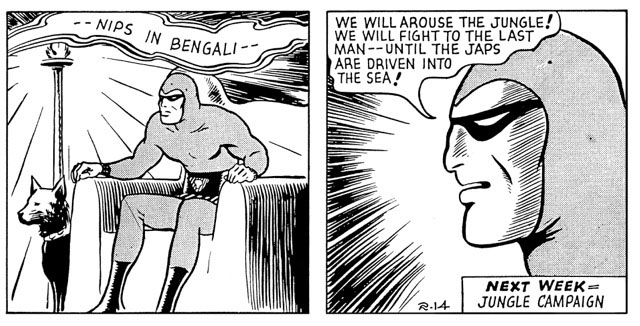
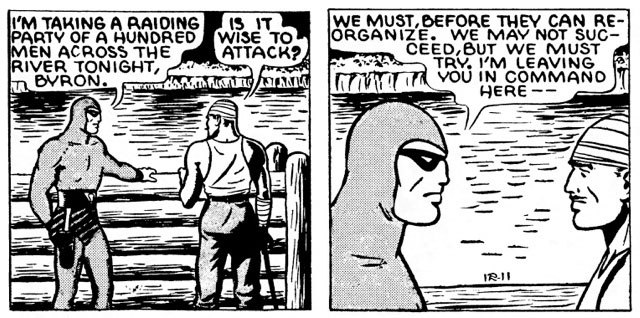
Wartime successor and regular artist through 1961; solely responsible for the artwork by 1949.
Bill Lignante and the 1961–62 transition
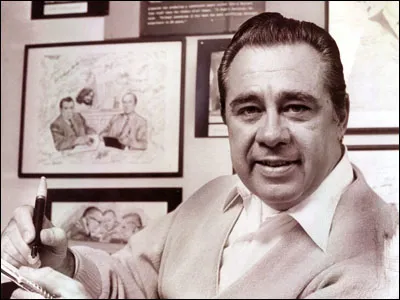 Bill Lignante
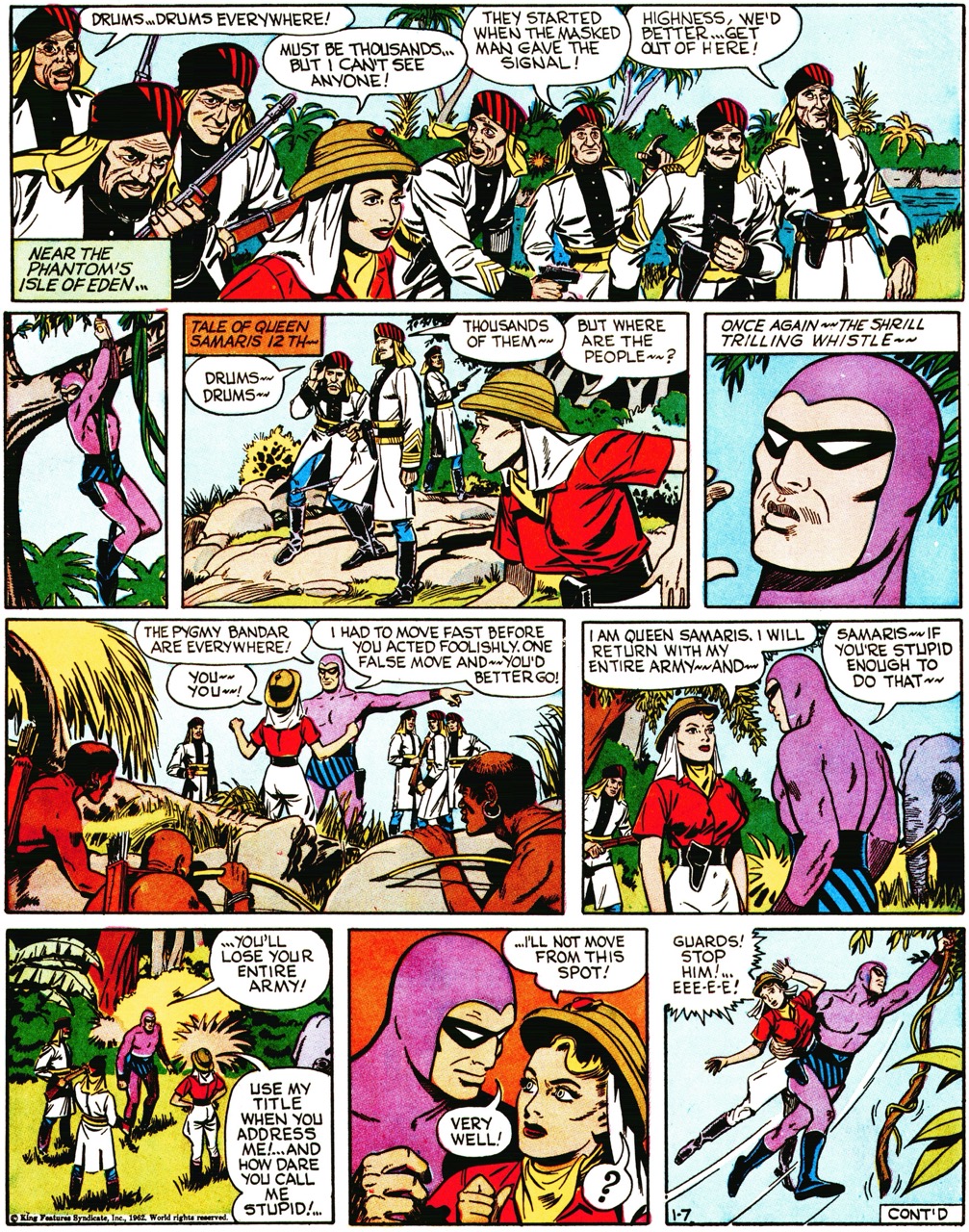
After McCoy’s death, the transition was not identical on the two newspaper tracks. The Sunday story The Limper carries contributions attributed to McCoy, Carmine Infantino and Bill Lignante. Lignante then drew Queen Samaris XII, published from November 1961 to May 1962. Barry had already begun on the daily strip.
This is a useful warning against judging the history by a single succession chart. A short assignment may be about completing an inherited story rather than announcing a new visual philosophy. Lignante’s much larger comic-book output is outside the scope of this page.
Sy Barry — the modern visual standard
 Sy Barry
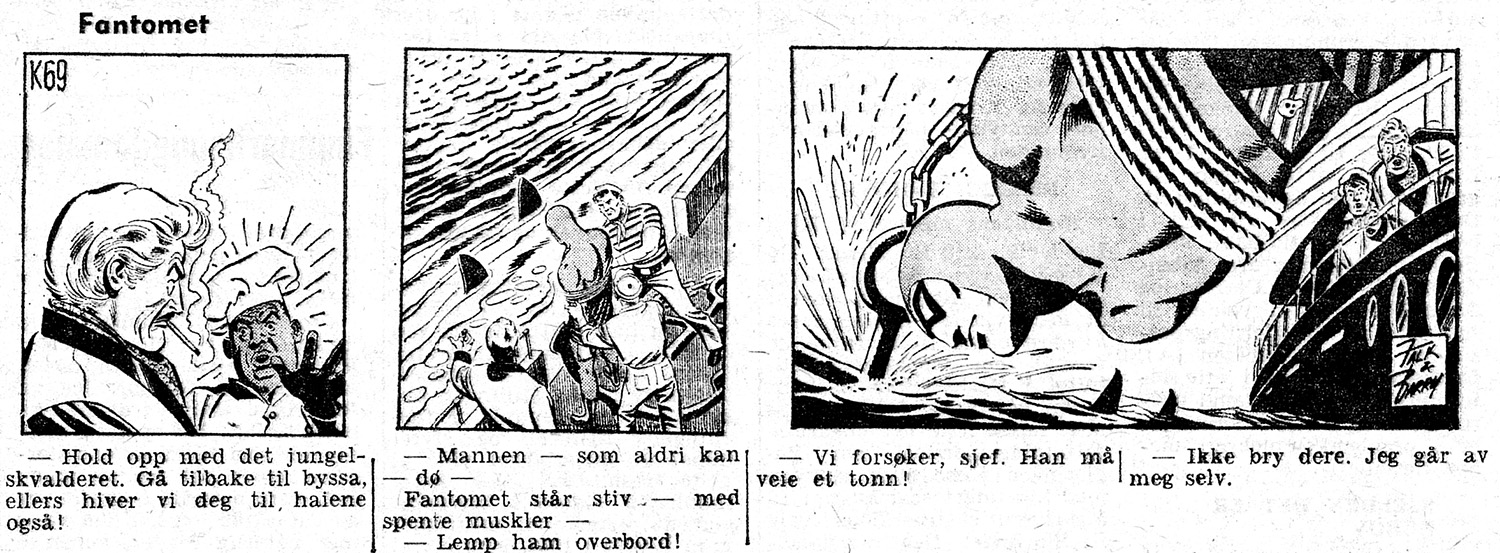
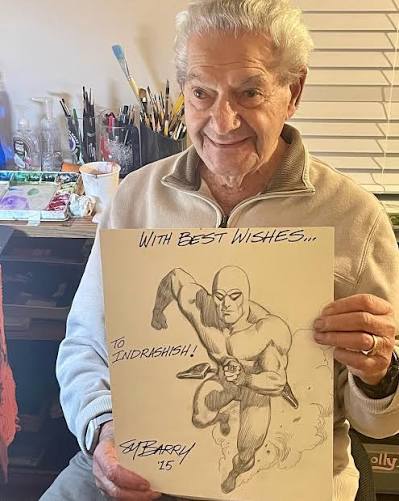
Barry’s daily debut was The Slave Market of Mucar. His first Sunday story was Treasure of the Skull Cave. His period with Falk also brought a modernized political setting, including President Lamanda Luaga and Colonel Worubu.
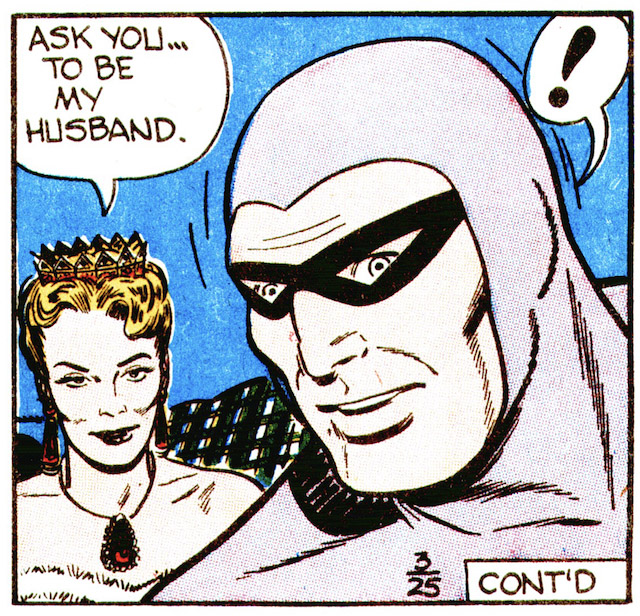
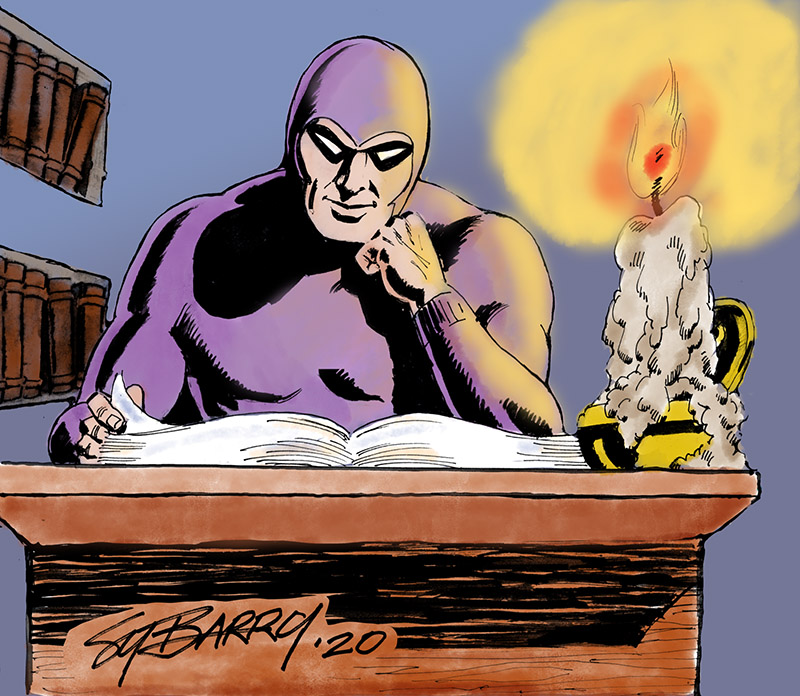
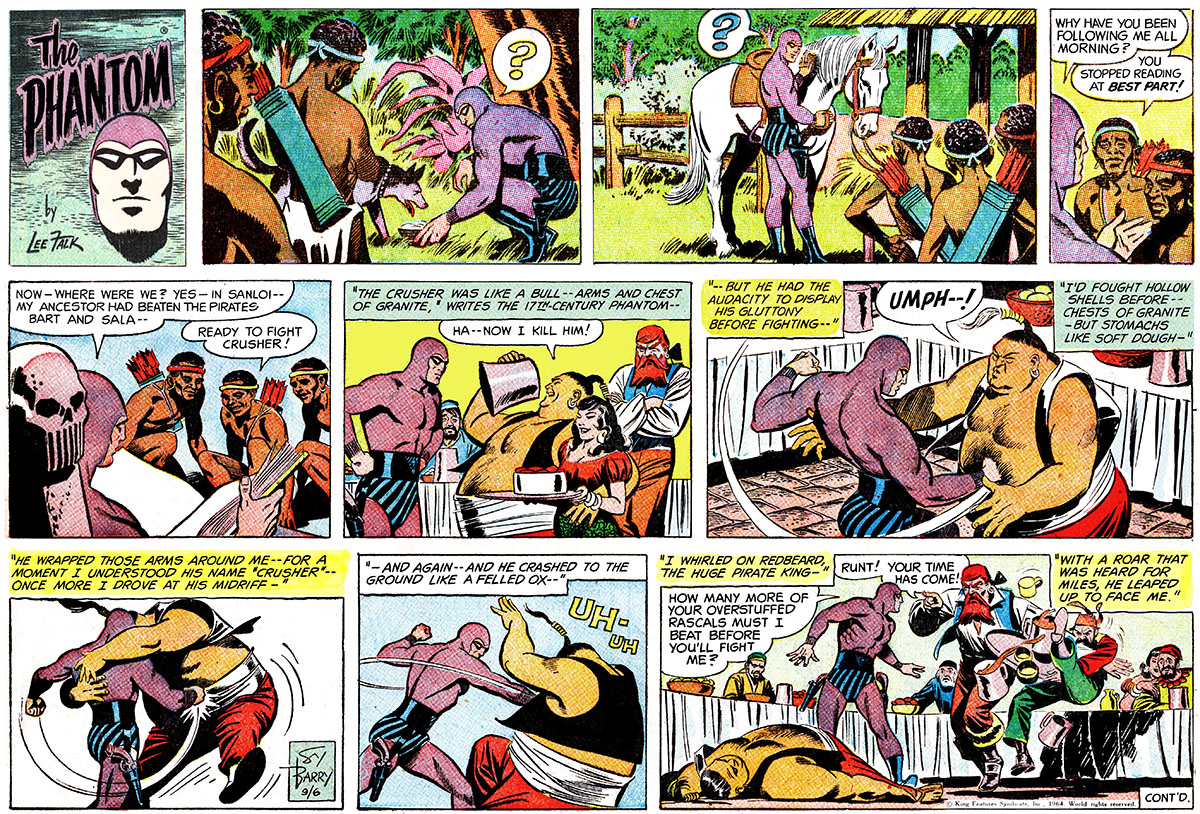
Barry’s Phantom is more anatomically defined and more firmly modelled than McCoy’s. For many readers, this became the familiar visual language of the character: a powerful but recognizable man, clear action and a polished adventure-strip finish. I see it as a substantial change in presentation that retains the central design.
The distinction matters. Drawing the established costume with different folds, proportions or brushwork is interpretation. Replacing its defining shapes and symbols would be a different kind of decision.
George Olesen, Keith Williams and Fred Fredericks — continuity as teamwork
Olesen’s importance reaches back into the Barry years. After Barry’s retirement, Olesen supplied pencils, with Williams inking the dailies. On Sundays, Erik Doescher — also listed as Eric Doescher — preceded Fredericks. The Olesen/Williams daily period continued until 2005; the Olesen/Fredericks Sundays ended in 2000.
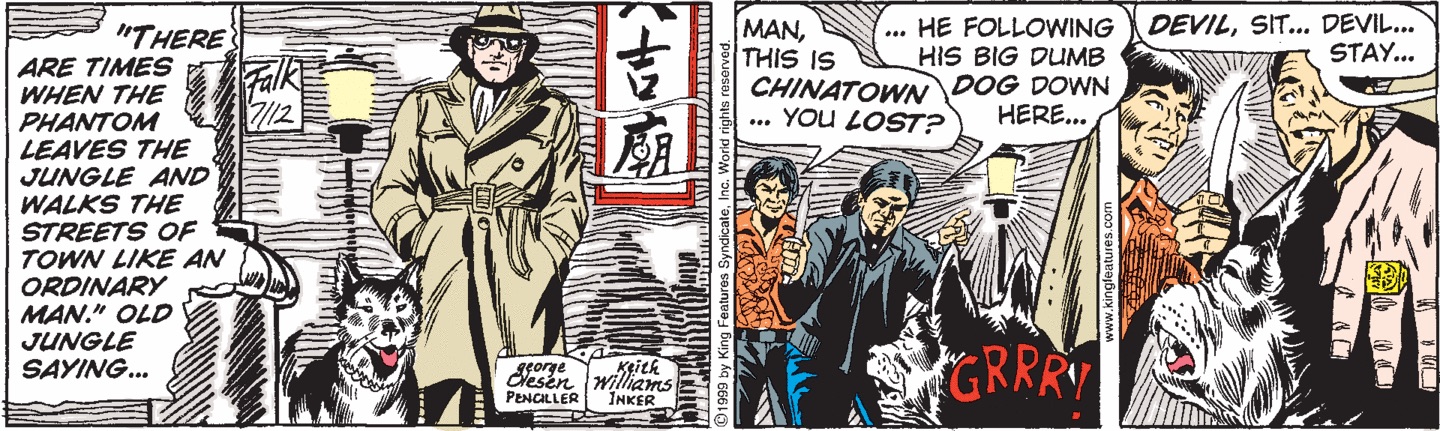
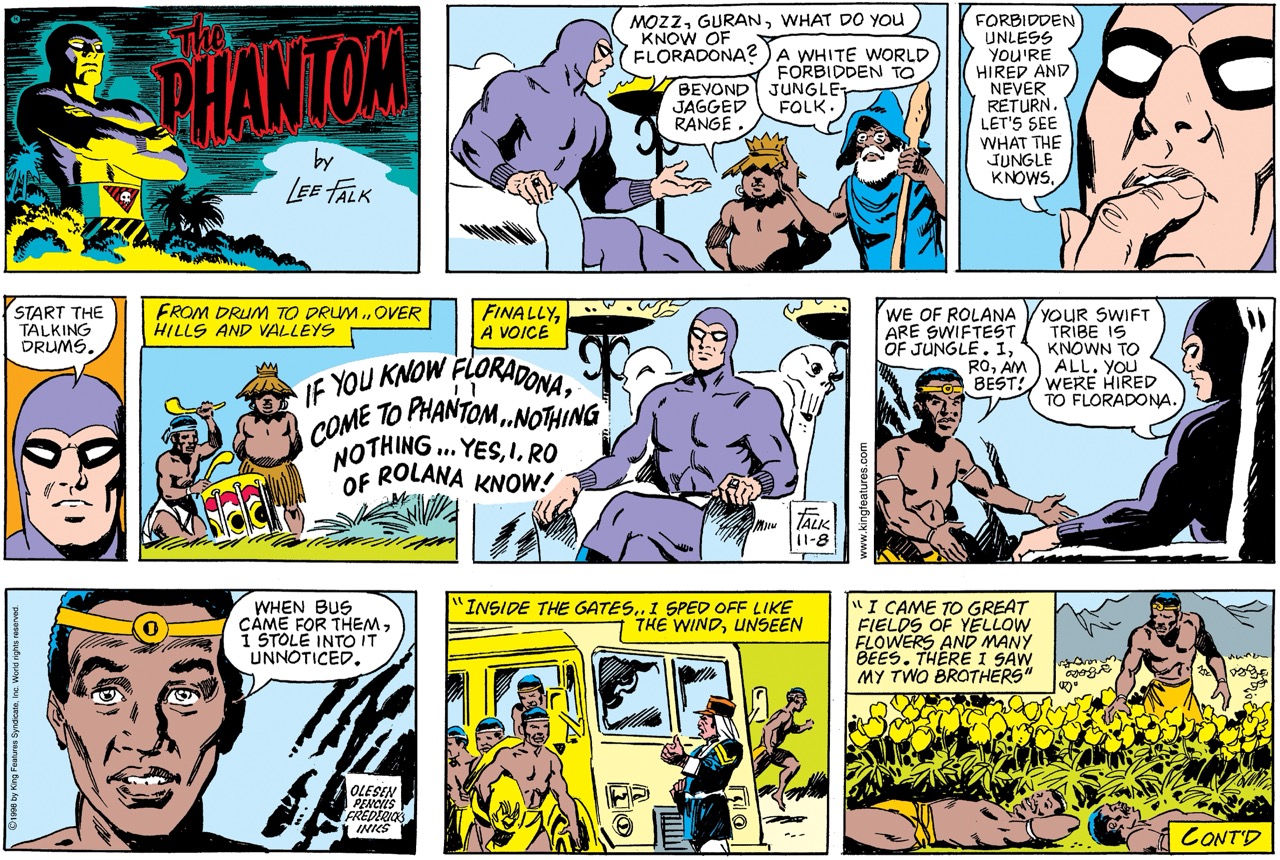
These collaborations make me cautious about saying that one person “owned” an era’s style. An inker affects the weight and texture of the finished image; a penciller determines much of its structure. Continuity can be the achievement of a team, including people whose names were not prominent on the printed strip.
Where I draw the line
Filling a gap should deepen the world
A previously unexplored journey, an ancestor’s missing adventure or the history of an object can offer room to develop what Falk left unexplained. The new explanation should fit what we already know and earn its place as a story.
There is no obligation to explain everything. Mystery is part of the appeal. Filling every blank can make the world smaller, particularly if the explanation is less interesting than the unanswered question.
The costume is part of the identity
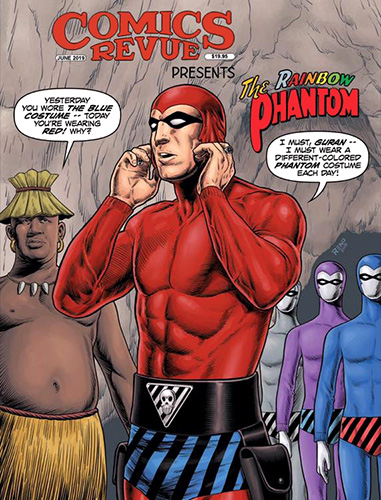
Here my position is firmer. Major alterations to the established costume are, for me, out of bounds in a continuation of the newspaper Phantom. The hood, mask, belt, striped trunks and recognizable overall design are not incidental packaging. They tell us who has entered the panel before a word is spoken.
This leaves plenty of room for individual drawing. Moore, McCoy and Barry already demonstrate that. Different proportions, line weights, folds and degrees of realism do not demand that we replace the design itself. Ordinary clothes, disguises or equipment required by a particular scene are another matter; they are not necessarily a permanent redesign of the Phantom.
When I say a major redesign is “not allowed,” I mean within my own standard of fidelity. I am not claiming that this is a clause in a King Features contract. A rights holder might authorize something that I still regard as the wrong choice.
A visible change needs a reason
“It has never been described before” is a starting point, not a complete justification. I also want to know what the addition does for the story. Does it explain a convincing gap, deepen a relationship or create a worthwhile problem? Can it coexist with the earlier strips?
If the only purpose is to leave a new creator’s stamp on the property, I remain unconvinced. There are many ways to leave a mark through memorable storytelling without altering a landmark simply because it is available to alter.
Keeping the inheritance recognizable
I want The Phantom to continue. That necessarily means accepting creators who are not Falk and artists who do not draw like their predecessors. It also means accepting that some new stories will please me more than others.
What I ask of a continuation is a sense of proportion. A distinctive drawing style is welcome. A well-founded addition to an unfinished corner of the world is welcome. A conspicuous alteration needs a purpose beyond being conspicuous. And the things that make the Phantom immediately recognizable deserve protection rather than periodic replacement.
The syndicate can keep the strip available. Writers and artists can keep it interesting. But continuity matters because the reader is returning to someone already known. For me, the best successors understand both halves of that responsibility: they have something of their own to contribute, and they know what they have inherited.