Tony DePaul: Writing the Phantom After Falk
On 15 October 2026, Tony DePaul announced that King Features had ended his assignment as writer of The Phantom newspaper strips. In his account, That's it for me and the Phantom, Part II, he makes a clear distinction from the contract dispute in 2017: then he had quit; this time the decision was the syndicate's. He says Amy Anderson told him on 14 October that King Features wanted to take the strip in a new direction and attract younger readers.
DePaul names Alex Segura as his successor, with the change taking effect in the daily strips dated 7 December 2026. His own last delivered daily strip is dated 5 December. The Sundays follow a different timetable: his final story with Jeff Weigel is already written and drawn, with material ready for publication into early April 2027. Readers will therefore continue to encounter his work after the end of the assignment.
The daily handover leaves a more immediate question. DePaul says the story in progress still required 109 panels and an epilogue beyond his last delivered strip. King Features has his notes, but he does not know whether Segura will follow them, devise another resolution or begin a new adventure. That uncertainty concerns the fate of the unfinished story, rather than whether DePaul is leaving. He speaks respectfully of his successor; his criticism concerns the way the transition was handled.
This confirmed change of writer gives a timely reason to look back, but the stories remain the main subject here. What has DePaul contributed during more than a quarter of a century with the newspaper strip, and how does his treatment of the Phantom compare with Falk's? For me, those questions also lead back to some correspondence from the beginning of his time on the strip.

My recollection is that he considered the material he received and worked with what he found useful. He also made his position quite clear when something did not appeal to him. It gave me an impression of a writer who wanted to understand the world he had inherited, but who would make his own decisions about how to use it.
Looking back over the newspaper stories, my broad feeling is that the strip has held up. There have been some strange choices, certainly, but that was hardly unknown in earlier years either. The Phantom has never been produced by a writer working in isolation: the relationship between writer and artist matters, and it matters when we try to judge what has changed.
Lee Falk remains the starting point. Without him there would be no Phantom, no family line and no legend to discuss. But DePaul has now spent more than a quarter of a century writing within that world. His contribution deserves more than being described simply as what happened after Falk.
From the Scandinavian comic books to the newspaper strip
DePaul did not arrive without previous experience of The Phantom. He had written stories for the Scandinavian comic books in the early 1990s. Fiery Revenge appeared in Fantomen in 1993, with artwork by Felmang and Germano Ferri. Other stories brought him together with artists such as Hans Lindahl, Kari Leppänen, Heiner Bade and César Spadari.
His professional background was in journalism. He spent 26 years as a newspaperman, including work for the Bangor Daily News and The Providence Journal. That background is useful context, although it would be too simple to explain every feature of his fiction by his previous occupation.
After Falk's death in March 1999, the newspaper strip went through a transition involving more than one writer. Claes Reimerthi also contributed to the post-Falk strip. It was not an immediate, completely tidy handover in which everything became DePaul's work overnight.
DePaul's first published daily adventure was The Ghost Wall, which began on 12 July 1999. In a later account he placed King Features' choice of him for the continuing assignment in the summer of 2000. Those dates describe different things: the first appearance of his work and the establishment of the longer-term arrangement.
He eventually became the continuing writer of both the daily and Sunday stories. The two formats retained their separate adventures. There was no general merging of the weekday and Sunday plots.
An inherited world, with room to add things
My early correspondence with DePaul is relevant because it reminds me that the legend was not a single, neatly indexed handbook. Falk had created a very large world across decades. The licensed comic books had supplied still more material, sometimes expanding his ideas and sometimes taking a different course.
Information could therefore be useful without becoming an instruction. Finding that something had happened in an Egmont story did not automatically mean that it had happened in the newspaper continuity. Nor did it mean that DePaul had to reject it. He could adapt a useful idea to a different version of the series.
A concrete example is Crocco Island West, published from 29 December 2008 to 25 April 2009, with art by Paul Ryan. The Crocco creatures had previously appeared in DePaul's Team Fantomen stories. Their newspaper appearance brought an idea across that boundary, with a substantially different visual design.
That is a transfer of selected material, not proof that every Scandinavian adventure has become part of the newspaper history. For anyone discussing the Phantom's past, the distinction still matters. A story's origin and the version in which we read it should not disappear simply because an idea has been reused.
New people who continued to matter
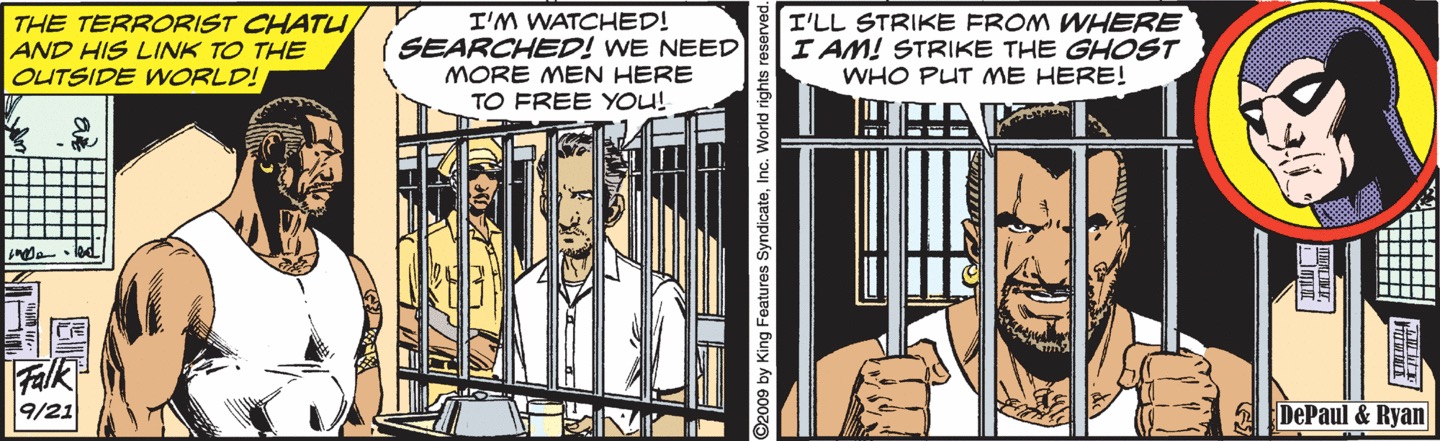
One conspicuous feature of DePaul's period is the way certain characters and conflicts keep returning. Chatu, the Python, is an especially important example. He becomes more than a criminal dealt with in one adventure. His actions reach the Phantom's home and family, and their consequences feed later stories.
Captain Savarna adds another lasting relationship. Her maritime adventures intersect with the family's affairs and later with the Gravelines stories. Her personal interests do not always fit comfortably with the Phantom's obligations. Together with figures such as the Nomad and his daughter Kadia, she helps create a network of relationships that one adventure does not simply clear away.
Falk certainly had recurring enemies and returning friends. The difference is one of emphasis: in important parts of DePaul's work, the aftermath of an adventure becomes the material for the next one.
The death of Diana—and the version Scandinavian readers received
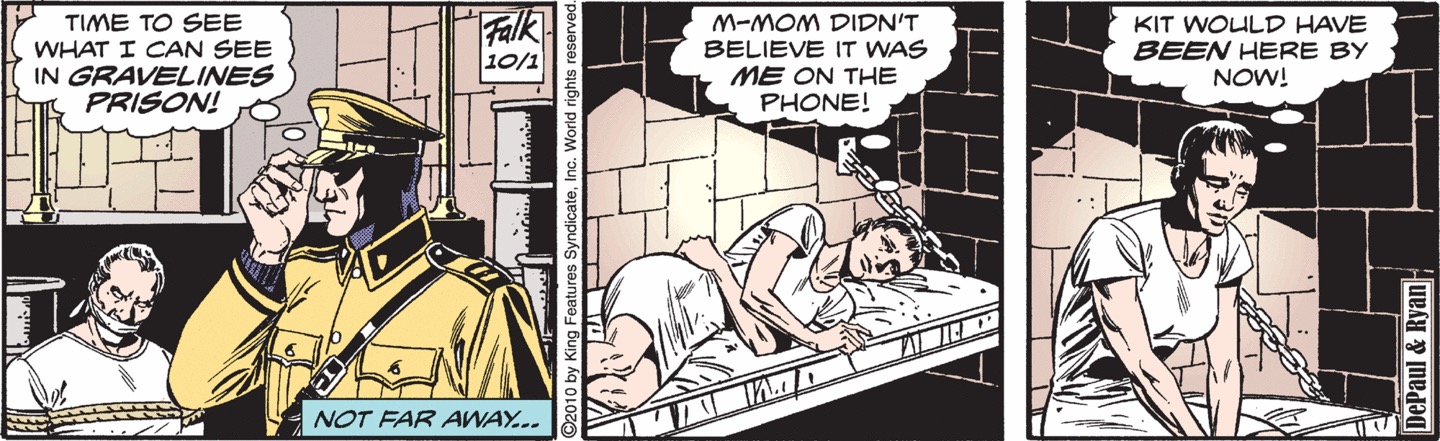
One of the clearest examples of DePaul's approach is the long daily sequence beginning with The Death of Diana Palmer Walker. Drawn by Paul Ryan, its five connected stories ran from 24 August 2009 to 7 May 2011: The Death of Diana Palmer Walker, The Phantom at Sea, Terror Cells of New York, The Trail to Gravelines Prison and Chatu's Fate. Norwegian readers know Diana as Sala, so for us this was the story of Sala's death.
The death is apparent. Chatu arranges an attack on the United Nations building in Mawitaan, but Diana has been abducted and secretly imprisoned. The reader knows she is alive while the Phantom believes he has lost her. That separation between what he knows and what we know gives the adventure much of its tension.
For me, the significance goes beyond the question of whether Diana will be found. Chatu attacks the man inside the legend. The Phantom's strength, experience and reputation cannot protect him from grief, and the consequences reach the children as well. A threat to his wife becomes a crisis for the whole family.
There is also a moral complication. The Phantom has previously saved Chatu's life; now that same enemy has apparently destroyed his own. Doing what he considered right has brought a terrible personal cost. DePaul can therefore ask an uncomfortable question: do the Phantom's principles still hold when he has the strongest possible reason to abandon them?
The eventual rescue does not immediately settle everything. The final chapter still has to deal with Chatu and with what the Phantom will do to him. I would not reduce that confrontation to a comfortable lesson in restraint. Its interest lies in how close a personal reckoning can come to the boundary between justice and vengeance. It is a useful earlier story to keep in mind when DePaul later discusses that distinction in his account of the first Phantom.
The length matters too. This is a sustained construction in which grief, pursuit, rescue and the confrontation with the person responsible occupy successive chapters. Whether every passage needs all the space it receives is open to discussion, but it is an important example of DePaul writing a larger saga through a series of separately titled adventures. Paul Ryan's contribution belongs in that assessment: the drama reaches us through his drawings as well as through the script.
There is, however, another aspect of its publication that I disliked. At this point, Team Fantomen's version of Bangalla did not have Luaga as president. Sandal Singh held that position, while Luaga worked as a doctor in Bengete. The newspaper story, in which Luaga remained president, did not fit that arrangement.
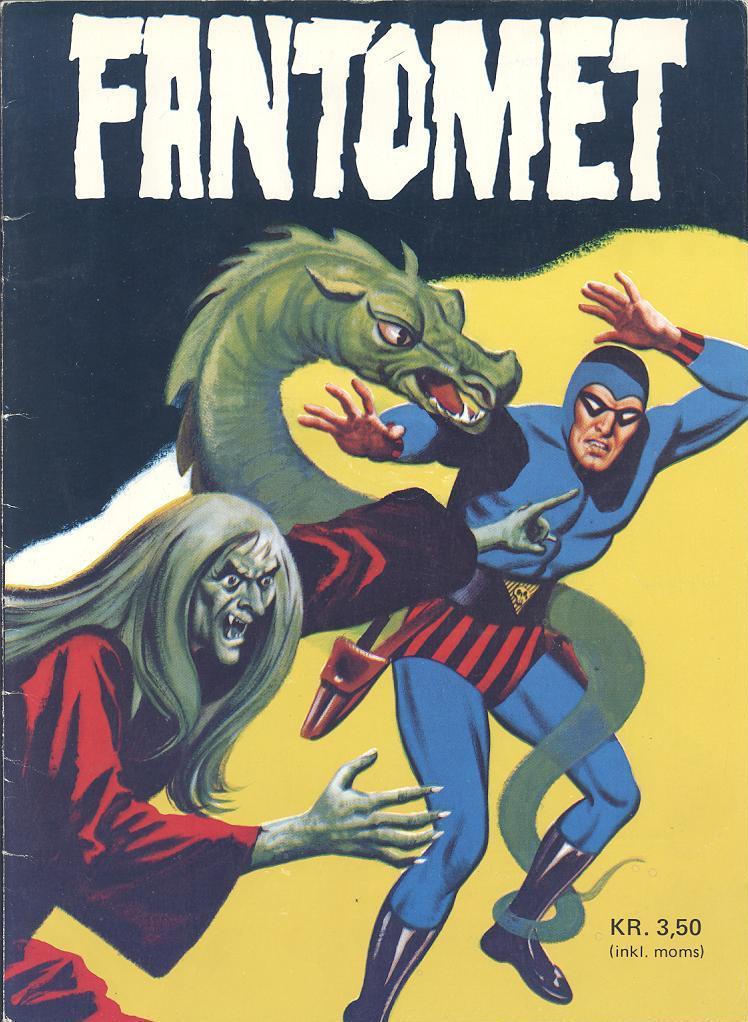
The Scandinavian edition was consequently altered. Ulf Granberg rewrote passages and Hans Lindahl supplied new artwork to accommodate the different political situation. The opening two daily stories were combined in the Norwegian Fantomet 1–2/2011 under the title … blant offrene: Sala Palmer-Walker. This was more than the familiar rearrangement of newspaper panels into comic-book pages. It changed the story's content and images to make the imported adventure conform to the magazine's own continuity.
Nor was this issue confined to the Diana sequence. Other newspaper stories involving President Luaga were adapted to the Scandinavian situation as well. For me, these alterations are a particularly clear example of the difficulty created when the newspaper strip and a licensee's continuing universe diverge.
I understand the editorial problem, but I do not like that solution. I would rather read the newspaper adventure on its own terms and accept that Team Fantomen tells stories in a partly different version of the world. Keeping those versions distinguishable seems preferable to rewriting one to make it agree with the other.
This matters in a profile of DePaul. A Scandinavian reader's impression of his work may partly be an impression of an editorial adaptation. If we are discussing his choices, his treatment of Luaga or his partnership with Ryan, we need to know which version we have read. I can enjoy Team Fantomen's own adventures while still wanting DePaul and Ryan's newspaper work to remain intact.
The children begin to have lives of their own
The twins are among the clearest examples of development within the familiar setting. The Twins' Futures in 2015–2016 and Farewell to the Deep Woods in 2016 move Kit and Heloise toward separate lives outside their childhood home.
Kit goes to the Himalayas, while Heloise's schooling in the United States brings her into contact with Kadia, the Nomad's daughter. Their friendship creates a complication that cannot be resolved simply by identifying a villain. Kadia is not responsible for her father's crimes. The decisions of the adults nevertheless affect the lives of the children.
This gives the saga a different forward pressure. The next Phantom is no longer only a distant idea attached to a family tradition. Kit must begin becoming a person who might take that responsibility, while Heloise also develops her own experiences and relationships.
It would be misleading to credit DePaul with introducing family life. Falk had already given us Rex, the marriage and the twins. DePaul's development lies in what he does with the family he inherited, particularly the consequences of letting the children leave the immediate protection of the Deep Woods.
Mozz, prophecy and the possible end of the line
The Curse of Old Man Mozz, published in 2017, made the Phantom's possible death an explicit subject. Later, the sequence beginning with To Wrack and Ruin at Gravelines in May 2021 developed prophecy into a much larger narrative device.
The important word is possible. A vision of the Phantom's death is not the same thing as announcing that the newspaper strip has permanently killed its leading character. The suspense concerns whether foreknowledge can change a decision, whether attempts to avoid a prediction help fulfil it, and what the Phantom owes to the people whose lives depend on him.
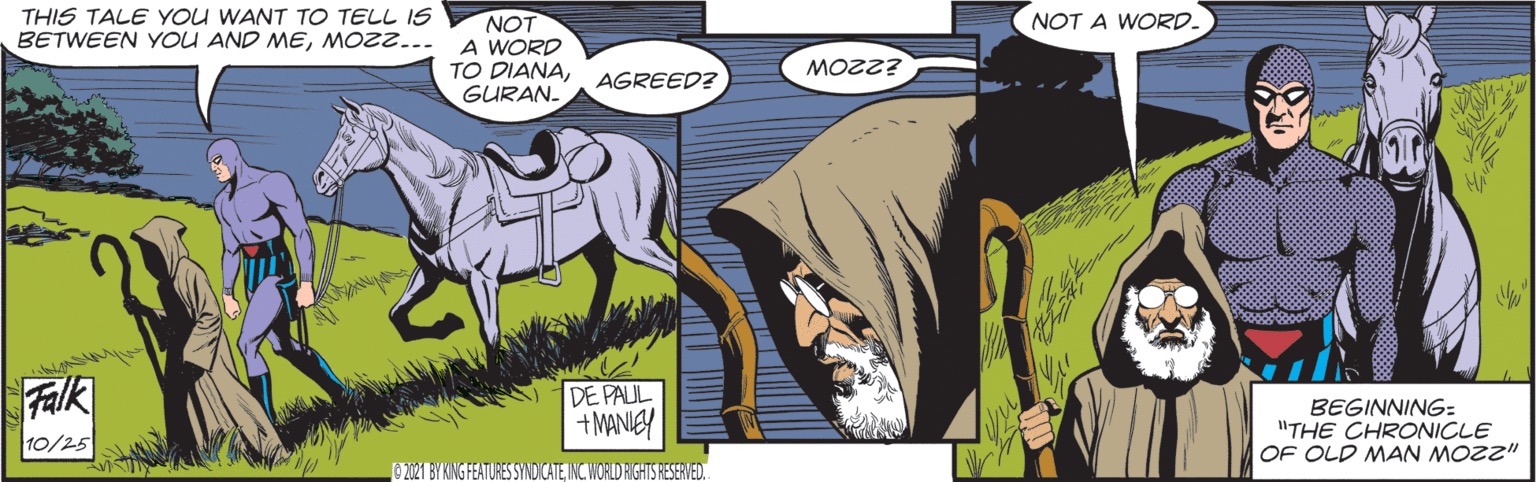
Across The Chronicle of Old Man Mozz, Death in the Himalayas, Phantom's End and the subsequent escape and return, individual titles function as chapters in a larger construction. Reading one in isolation may obscure why particular choices have such weight.
This also brings a practical difference for readers. An extended sequence can reward careful, continuous reading. It can be harder to enter halfway through, especially in newspapers or reprints that are not all publishing the same part at the same time. Whether the greater length improves a particular story remains a matter of judgment; length alone is not a measure of quality.
Returning to the beginning—another telling of the legend
The origin received renewed attention in 2025, in the opening of The Spark. In 2026 DePaul and Jeff Weigel followed it with the Sunday story 1536, published from 1 February to 27 September. It concentrates on how a shipwrecked young man came to establish a life and a role among the Bandar.
It is a long story, as several of the more recent Sunday adventures have been. I suspect that this tendency has more to do with the direction King Features wants for the Sunday strip than with DePaul alone. That is my impression, rather than something I know from the editorial office, but I would hesitate to place the responsibility for the length entirely on the writer.
As for changing the origin—well, is it really such a substantial change? If we take Falk and Sy Barry's The First Phantom from 1975 as the definitive account, there are certainly differences. DePaul himself has described his approach as deliberately departing from parts of that story, particularly its portrayal of the Bandar. But I am not convinced that the 1975 adventure should bear the weight of being a final statement of the legend.
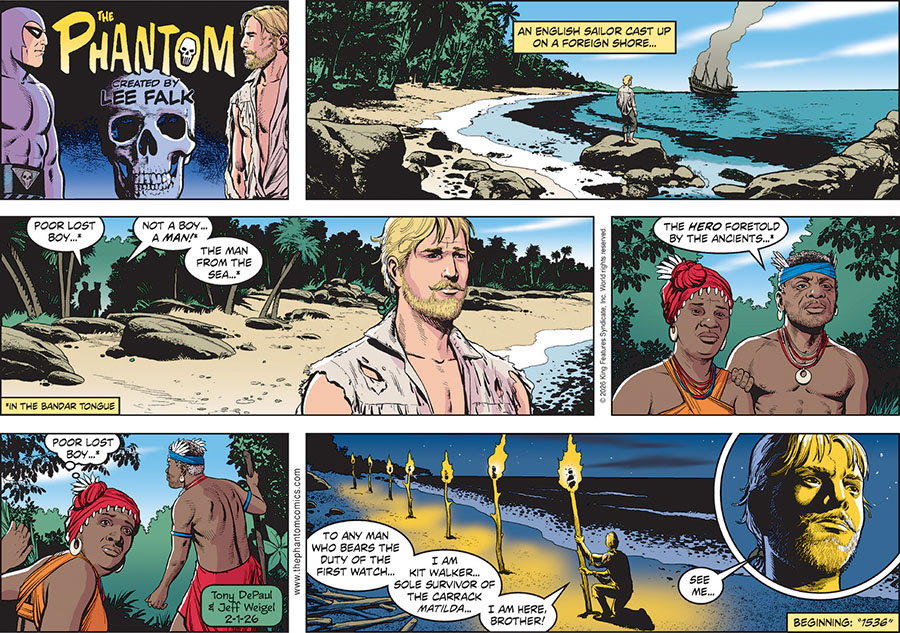
For me, the more important reference points are the introductions repeated across countless newspaper adventures. Even those are never entirely consistent. Details shift, events are compressed, and the emphasis changes according to the story being told. Falk gave us a powerful founding idea, but not one fixed account in which every detail always agreed.
That is why I am more inclined to read 1536 as an expansion of what Falk wrote than as a contradiction of it. There is room between the familiar landmarks for a longer account of how the young survivor found his place, and how the people around him became part of the legend. A different emphasis does not necessarily overturn the whole idea.
DePaul's own account of the work helps explain that approach. He asks what happened between the shipwreck and the oath: why would a young sailor decide to remain instead of trying to get home? He describes the story as filling that unexplored interval. That is close to the way I read it, even though he has also acknowledged deliberate departures from the 1975 version.
His central concern is the making of a moral character. Kit has to distinguish justice from the satisfaction of revenge. DePaul openly links that concern to his criticism of contemporary American politics, particularly the Trump administration. That connection is his stated intention, not something we need to infer from the panels. He sees it as part of the tradition of moral storytelling Falk established; readers can judge how well the contemporary purpose serves the adventure.
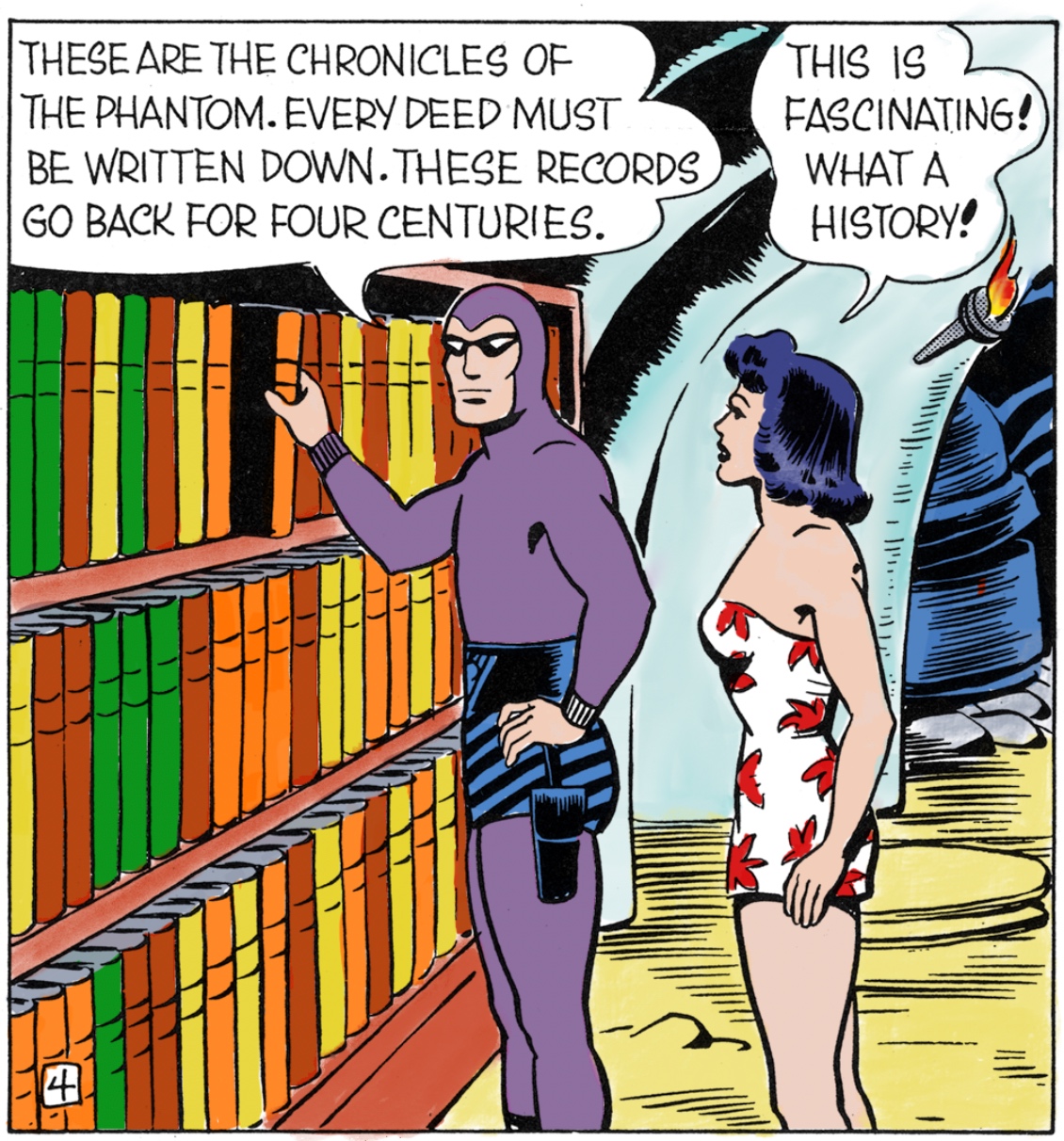
The ending provides another useful frame. We discover that the present Phantom has been reading his ancestor's account in the Chronicles. That does not make the events untrue within the fiction, but it does make their presentation a story handed down and read by someone else. It suits my reluctance to treat this—or the 1975 adventure—as the last word on every detail of the legend.
DePaul also explains the relationship between this beginning and The Death of the 21st Phantom. He and his collaborators had wanted to tell an ending in case publication someday ceased without warning. The two works thus stand at opposite ends of the legend. His explanation concerns the uncertain future of newspaper publishing; it should not be read as a statement about a particular employment decision.
Nor do I think DePaul's version has to become a final manifesto. It, too, is a story: a particular telling of the beginning, with its own purpose and perspective. I can consider how well it works without treating every scene as a rule that all future Phantom adventures must obey. Falk's stories deserve the same freedom to be stories, rather than being made to carry the burden of an entirely consistent historical record.
Is this substantially different from Falk?
Yes, in several respects, although a comparison needs to allow for the enormous range of Falk's own work. The author who wrote the early adventures was also the author who later introduced political change in Bangalla, married the Phantom and Diana, and gave them children. Falk did not write one unchanging kind of story for 63 years.
As a reading comparison, I would describe the difference this way: Falk often makes the legend feel immediately present. A short explanation, an old saying or a glimpse into the Chronicles can be enough to open a much larger world. He does not always stop to explain every mechanism behind it. That looseness can leave contradictions, but it can also help give the stories their ease and their sense of wonder.
DePaul more often makes the explanation itself part of the adventure. What does the inherited role require of the family? What might a prophecy do to a man's judgment? What follows from an enemy learning something that was previously secret? In the origin stories, what choices would actually lead a survivor to stay?
These are tendencies rather than rules. Falk could be reflective and DePaul can be funny or direct. Nor is one approach automatically better. A closely connected saga can gain emotional weight, while an apparently simple Falk adventure can achieve its effect with remarkable economy.
There is also a difference of position. Falk was inventing the legend, even when he contradicted or revised his own inventions. DePaul writes after that body of work exists. When he alters it, the reader can compare the new explanation with an identifiable earlier story. He is simultaneously a storyteller and an interpreter of a predecessor.
The artists are part of the answer
DePaul's years include daily work drawn by George Olesen and Keith Williams, Paul Ryan and Mike Manley, as well as contributions by other artists. On Sundays he has worked with artists including Graham Nolan, Ryan, Eduardo Barreto, Terry Beatty and Jeff Weigel. The changing appearance of the strip cannot all be laid at the writer's door.
A script becomes a page through choices about faces, atmosphere, movement and the arrangement of panels. The same scene may feel light, threatening or intimate depending on how it is drawn. This was true of Falk's partnerships, and it remains true of DePaul's.
The lengthy Ryan adventures, Manley's daily work and Weigel's Sunday pages therefore deserve to be considered as collaborations. When I think that a particular period has worked well—or that something feels strange—I want to keep that partnership in view.
Stories that help show the development
This is a selected working list, not a ranking or a complete bibliography. Dates refer to original newspaper publication. A larger sequence may extend beyond the dates of its opening chapter.
| Story or sequence | Original period | What it helps illustrate |
|---|---|---|
| The Ghost Wall | 12 July–20 October 1999 | DePaul's first published daily adventure in the post-Falk transition |
| The Patrolwomen | 7 January–3 May 2008 | Development within the Jungle Patrol setting |
| Crocco Island West | 29 December 2008–25 April 2009 | An idea from Team Fantomen adapted for the newspaper continuity |
| The Death of Diana Palmer Walker and its continuations | 24 August 2009–7 May 2011 | Family danger and consequences sustained across five daily stories |
| The Twins' Futures; Farewell to the Deep Woods | 2015–2016 | The children moving toward separate lives and responsibilities |
| The Curse of Old Man Mozz | 13 March–23 September 2017 | Prophecy and the possibility of the present Phantom's death |
| The Gravelines/Mozz sequence | May 2021–January 2024 | A large connected narrative about choices, foreknowledge and obligation |
| The Spark | 27 January–14 June 2025 | A renewed presentation of the origin, followed by Kit's story |
| 1536 | 1 February–27 September 2026 | A fuller origin story, read here as an expansion of Falk's varying accounts |
A provisional assessment
My overall impression remains that the newspaper strip has held up. That does not require me to approve every choice, or to treat every attempt to explain the legend as an improvement. It means that I have continued to recognise The Phantom in stories written by someone other than Falk.
The correspondence I remember belongs at the beginning of that assessment. DePaul was interested in what had already been done, including material outside the newspaper strip, but he also had opinions about what he wanted to carry forward. His later work makes that independence increasingly visible.
Falk created the world. DePaul has continued it, added to it and offered further ways of telling its history. I do not necessarily see a new account of the beginning as a rejection of the old one. Those contributions can be assessed separately without reducing either writer to a slogan. His place in the series rests on the stories themselves: the family drama, the recurring consequences, the moral questions and the collaborations through which he has continued Falk's creation.